
10/13/2026
How AI Workloads Are Changing Cloud Infrastructure
Artificial intelligence is changing how businesses build and operate modern applications. As organizations deploy machine learning models, generative AI applications, and AI-powered services at scale, cloud infrastructure needs to handle demanding workloads efficiently. This is where Kubernetes and AI are becoming increasingly important.
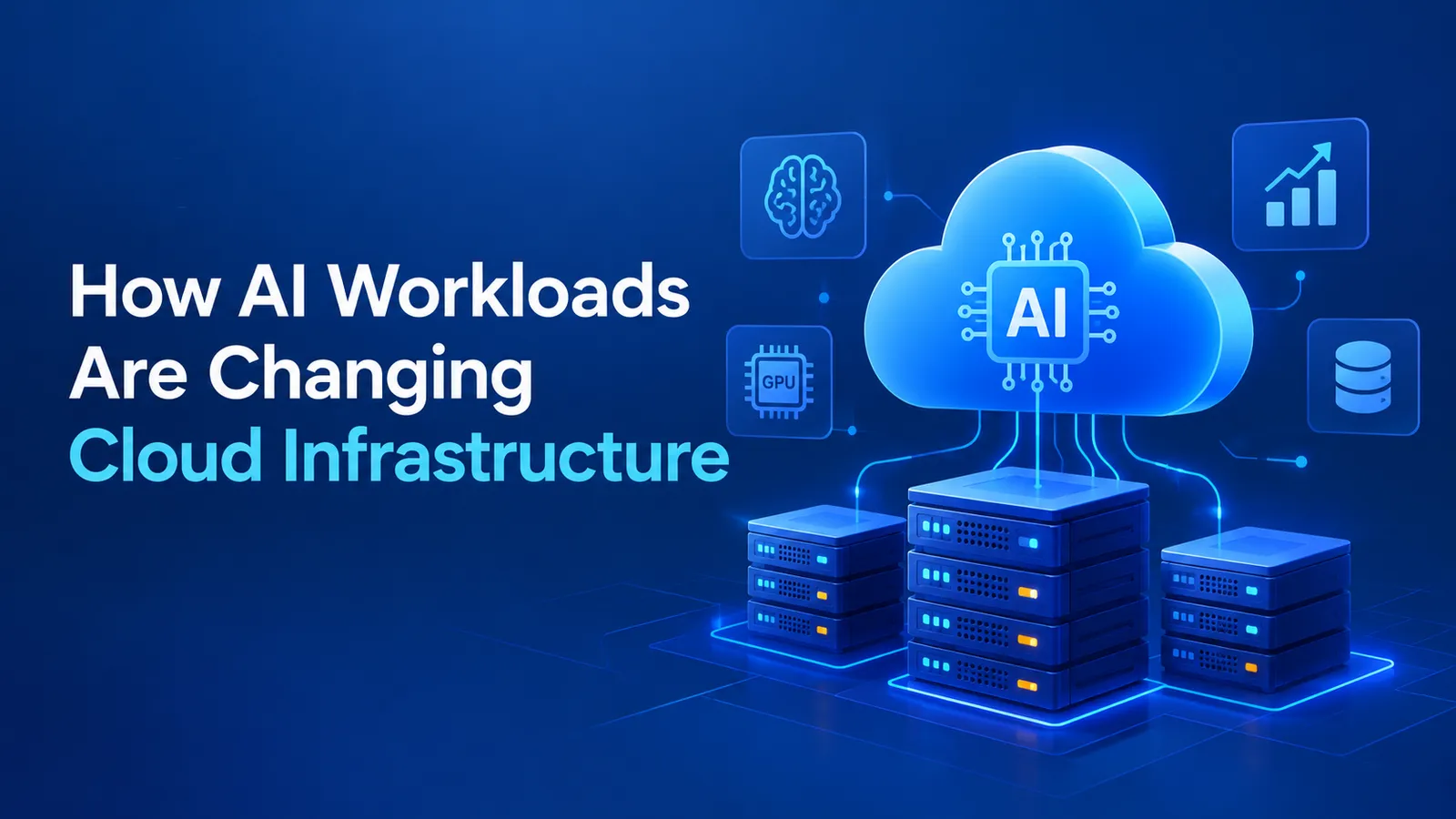
Kubernetes provides a flexible platform for deploying, scaling, and managing containerized applications. When combined with cloud infrastructure and specialized computing resources, Kubernetes can help organizations manage the complex requirements of modern AI workloads.
What Is Kubernetes?
Kubernetes is a powerful platform for managing container-based applications, helping teams efficiently deploy workloads, adjust resources as demand changes, and maintain applications across distributed cloud environments. For AI applications, Kubernetes can help manage containers running machine learning models, data processing services, APIs, and supporting infrastructure. It can also help organizations distribute workloads across available computing resources.
Why Are AI Workloads Different?
Traditional applications often have relatively predictable resource requirements. AI workloads can be significantly more demanding. Training and running AI models may require:
High-performance CPUs
GPUs or other accelerators
Large amounts of memory
High-speed storage
Fast network connections
Scalable computing resources
AI workloads can also vary significantly. Model training may require substantial resources for a limited period, while an AI application serving users may require resources continuously. This makes flexible infrastructure and efficient resource management particularly important.
How Kubernetes Supports AI Workloads
1. Scalable AI Infrastructure
Kubernetes allows organizations to manage containerized workloads across clusters. Resources can be adjusted according to application requirements, making it suitable for AI environments that experience changing workloads. For example, an organization may require significant computing capacity while training a model but much less capacity during periods of lower activity.
2. GPU and Accelerator Management
Many AI workloads depend on GPUs and other specialized hardware. Kubernetes can help schedule workloads that require these resources and allocate available infrastructure according to defined requirements. This can improve resource utilization and help teams manage AI infrastructure more efficiently.
3. Containerized AI Applications
Containers provide a consistent environment for packaging applications and their dependencies. Kubernetes can orchestrate these containers across development, testing, and production environments. This makes it easier for teams to deploy AI models and supporting services consistently across cloud infrastructure.
4. Automated Deployment and Scaling
AI applications often need frequent updates as models, APIs, and supporting components evolve. Kubernetes can work with CI/CD pipelines to automate application deployment. Organizations can also configure scaling mechanisms to respond to changing workloads. This creates a foundation for AI-powered DevOps and cloud automation.
Kubernetes, AI, and Cloud Computing
Cloud platforms such as AWS and Azure provide computing, storage, networking, and specialized hardware that can support AI workloads. Kubernetes adds an orchestration layer that helps organizations manage applications across these resources. This combination can be particularly useful for businesses building:
Generative AI applications
Machine learning platforms
AI-powered APIs
Data processing systems
Enterprise AI applications
Real-time AI services
Organizations can choose infrastructure based on workload requirements while using Kubernetes to manage containerized applications.
Challenges of Running AI on Kubernetes
Although Kubernetes offers flexibility, deploying AI workloads introduces additional challenges.
Cost Management: Cost management is one major consideration because GPU and high-performance infrastructure can be expensive. Businesses need to monitor resource utilization and avoid leaving expensive resources idle.
Complexity: Complexity is another challenge. Kubernetes environments require knowledge of containers, networking, storage, security, monitoring, and infrastructure management.
Security: Security is also important. AI workloads may process sensitive business data, making access controls, network security, secrets management, and monitoring essential.
How 2Cloud Can Help
Managing Kubernetes and AI infrastructure requires expertise across cloud computing, DevOps, AI development, automation, security, and cost optimization.
2Cloud helps businesses build and modernize their technology environments through DevOps and cloud services, AI development, AWS and serverless solutions, enterprise software development, mobile app development, cloud cost optimization, and software testing.
Whether you are planning to deploy an AI application, modernize your Kubernetes infrastructure, optimize cloud resources, or build a scalable enterprise platform, 2Cloud can help you choose and implement the right cloud and DevOps strategy.
Ready to Build Scalable AI Infrastructure?
Contact 2Cloud to discuss your Kubernetes, cloud, DevOps, or AI requirements and turn your AI workloads into reliable, production-ready solutions.
Frequently Asked Questions
What is Kubernetes used for in AI?
Kubernetes can be used to deploy, manage, scale, and orchestrate containerized AI and machine learning workloads across cloud infrastructure.
Why is Kubernetes useful for AI workloads?
Kubernetes provides workload orchestration, container management, scalability, automation, and resource scheduling, which can help organizations manage complex AI applications.
Can Kubernetes manage GPUs?
Yes. Kubernetes can schedule workloads that require GPUs and other specialized computing resources when the appropriate infrastructure and configuration are available.
Is Kubernetes good for generative AI?
Kubernetes can provide an infrastructure platform for deploying generative AI applications, model-serving systems, APIs, and supporting services. The right architecture depends on workload requirements, model size, traffic, and available computing resources.
Conclusion
Kubernetes and AI are becoming an important combination for modern cloud infrastructure. As AI workloads become more complex, organizations need infrastructure that can provide scalability, automation, resource management, and operational flexibility. Kubernetes can provide the orchestration foundation, while cloud platforms provide the computing resources required to run demanding AI applications. For businesses planning to scale AI workloads, the combination of Kubernetes, cloud infrastructure, DevOps automation, and effective cost management can provide a strong foundation for building reliable and scalable AI solutions.